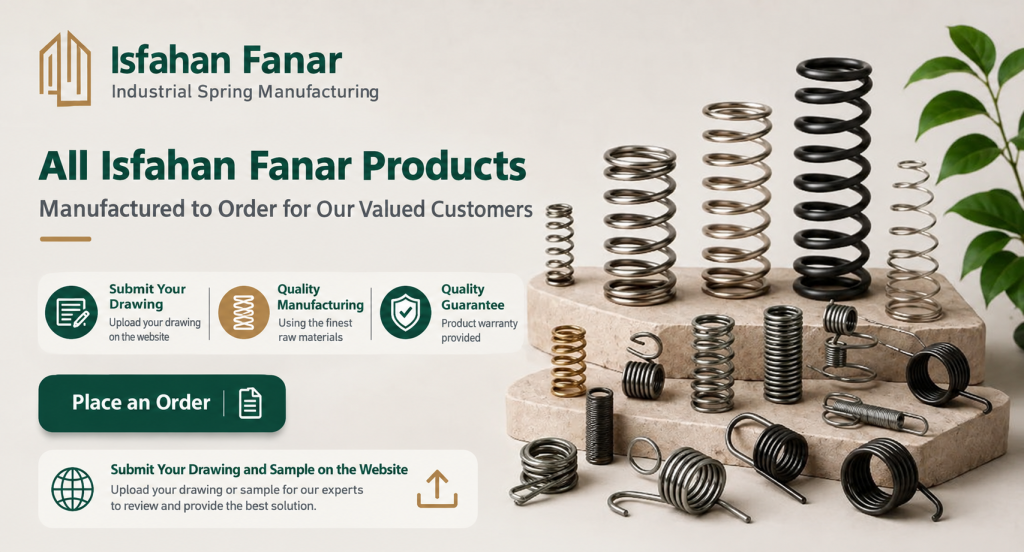
Purchase various types of industrial and custom-made springs.
Isfahan Fanar is a manufacturer of various industrial and custom-made springs in a wide range of models and dimensions. Its product portfolio includes compression springs, extension springs, torsion springs, coil springs, flat springs, and disc springs. These springs are manufactured to meet specific customer requirements for diverse applications across industries, machinery, the automotive sector, and mechanical equipment and components.
What technical specifications should you send us?
- Spring type
- Quantity
- Material type
- Spring length (L)
- Wire thickness (d)
- Spring diameter (D)
- Spring pitch (p)
If you do not have a plan, please contact us for explanations or expert consultation.
09135800108
031-4583952

Wire rod in coils is a widely used steel product manufactured in a continuous, coiled form; it serves various industries in the production of wire, metal components, and industrial goods. The wire’s quality, diameter, and material play a crucial role in its selection for specific applications.
What is coiled rebar, and what are its applications?
Coiled rebar is a widely used steel product in the construction industry and various industrial processes, manufactured and supplied in a continuous, coiled form. Unlike straight-length rebar, which comes in fixed, linear sections, this product is wound into a coil, making it easier to transport and utilize in certain manufacturing operations.
Key factors to consider when selecting coiled rebar include the steel grade, diameter, production method, and surface quality. It is used in the production of wire rods, metal components, steel structures, and various construction products.
What is rebar coil?
Coiled rebar is a steel product with a round cross-section that is wound into continuous coils following the production process. This type of rebar can be manufactured from plain carbon steel or from steels suitable for specific applications.
Its coiled form allows the product to be used in processes requiring continuous lengths, eliminating the need to join multiple straight bars. The diameter and steel grade determine the mechanical properties of the coiled rebar.
Difference between coiled rebar and straight-bar rebar
The most significant difference between these two products lies in their form of supply. Straight-bar rebar is produced in specific lengths, whereas rebar in coil form is packaged as a continuous, coiled strand.
This specific structure makes coiled rebar a suitable choice for processes such as wire drawing, wire manufacturing, and the production of certain metal components.
Types of coiled rebar
Coiled rebar types can be categorized based on steel grade, application, and mechanical properties. The appropriate type should be selected according to the intended application process.
Plain coiled rebar
This type features a simple, smooth surface and is used in numerous industrial and manufacturing processes. Its ductility and formability enhance its utility in the production of wire and metal components.
Deformed coiled rebar
Some products are manufactured with ribs and are used in applications requiring greater bonding with concrete. The shape and type of the ribs must comply with the product standard.
Industrial coiled rebar
Industrial coiled rebar is used in manufacturing processes such as drawing, wire making, and the production of metal parts. Surface quality and the uniformity of mechanical properties are of great importance in these products.
Coiled Rebar Specifications
Coiled rebar varies depending on the product type and manufacturing standard. Diameter, weight, steel grade, tensile strength, and surface quality are among the most important parameters to consider when purchasing.
Coil diameter and weight
It is important to know that the rebar diameter affects the weight of each coil as well as the process of using it. The final weight is also determined by the product’s diameter and length.
Steel type and grade
The steel grade determines the product’s mechanical properties and processability. For various processes, a steel must be selected that possesses the necessary strength and ductility.
Surface quality
The surface of the rebar must be as uniform as possible and free from defects that could interfere with the drawing or forming process.
Coil rebar size
The size of coiled rebar is determined by the diameter of the wire rod or rebar itself and is a key factor in product selection. Various diameters are manufactured to suit different applications.
Selecting the appropriate size is crucial in industrial processes, as the product diameter must be compatible with drawing machines, forming equipment, or the final product.
Factors influencing size selection
The required force, application method, equipment used, and the final product are key factors in selecting the diameter of coiled rebar.
For bulk purchases, it is also advisable to compare the product’s technical specifications with the production line’s requirements before placing an order.
Applications of coiled rebar
Coiled rebar is used in various industries. Its most important applications include:
Production of steel wire rod
Manufacturing of wire and wire products
Production of metal parts
Drawing and rolling processes
Manufacturing of certain types of metal mesh
Production of construction products
Manufacturing of industrial components
Production of various metal equipment and structures
In many manufacturing processes, the continuous form of the coil allows for the continuous feeding of machinery.
Applications of coiled rebar in construction
In the construction industry, the appropriate type of rebar coil can be used in the manufacture of certain steel products and in operations related to rebar installation. The product type and size must be selected based on the project’s plans and standards.
Industrial applications of coiled rebar
Factories producing wire and metal parts use coils as raw material. The consistent quality of this product can influence the quality of subsequent processes.
Advantages of coiled rebar
Its ring-like shape is the most important feature of this product, offering various advantages in terms of handling, storage, and processing.
Suitable for continuous processes
The coil can be fed into certain production machines without the need for repeated joining of rod ends. This feature is of great importance for wire drawing and production processes.
Easier transportation and storage
The ring-shaped structure allows for the accumulation of a large volume of product into a single unit. However, the weight of each coil must be compatible with the capacity of the handling and transport equipment.
Processability and formability
Suitable rebar coils can be used in drawing, bending, and wire-making processes. Selecting the appropriate steel grade at this stage is of particular importance.
Variety in size and grade
The availability of products with various diameters and specifications makes it possible to select the suitable option for diverse applications.
Coiled Rebar Buying Guide
When purchasing rebar coils, the intended end-use must first be determined. Subsequently, the diameter, steel grade, coil weight, and required standard should be checked.
Important Buying Tips
-
-
Specify the type of rebar.
Determine the required size.
Check the steel grade.
Inspect the surface quality.
Coordinate the coil weight with handling equipment.
Consider the project’s required standards.
Check storage and handling conditions.
Selecting a product based solely on price can affect the quality of the final process.
-
Coiled rebar price
The price of rebar coils depends on various factors such as diameter, steel grade, coil weight, manufacturing quality, and steel market conditions.
To compare prices, it is best to compare products with identical technical specifications. Differences in grade or diameter can lead to significant price variations.
Frequently Asked Questions About Rebar Coils
What is rebar coil?
It is a type of steel product manufactured and supplied in the form of continuous coils, used in construction and industrial applications.
What is it used for?
This product is used in the production of wire, metal parts, mesh, and steel products, as well as in certain industrial and construction processes.
How is the size of coiled rebar determined?
It is usually specified based on its diameter. Selecting the appropriate diameter depends on the application and the usage process.
What is the difference between coiled rebar and straight-bar rebar?
Coiled rebar is supplied in a continuous, ring-like form, whereas straight-bar rebar is provided in specific, fixed lengths.
Overall, coiled rebar is considered a key raw material in the steel industry due to its continuous structure, range of sizes, and versatility across various processes. Selecting the right product—based on grade, diameter, surface quality, and intended application—can lead to superior performance and facilitate easier processing.
-
Links to other products
- Compression spring
- Conical spring
- Extension spring
- Torsion spring
- Spiral spring
- Formed spring
- Oil seal garter spring
- Trampoline sprin
- Equipment spring
- Stitching wire
- Fishing spring
What factors determine the price of a spring?
If you intend to purchase high-quality coil springs, understanding these factors will help you allocate a more accurate budget for the project:
1. Material of the wire used:
The most important determining factor is the type of wire used. Springs made from CK75 or SUP9 spring steel, or from alloy wires, are more expensive than those made from standard galvanized wire. Springs made of 304 and 316 stainless steel—used in corrosive environments and the food industry—are the most expensive option among the various types of springs.
2. Wire diameter and coil diameter:
The greater the wire diameter, the higher the spring’s weight and, consequently, its price. The ratio of the coil diameter to the wire diameter (the spring index) also directly affects the difficulty of the forming process and the cost of custom spring production.
3. Number of coils and free length of the spring:
Each additional coil means higher wire consumption and a longer production time. Naturally, long springs with a large number of coils command a higher price.
4. Heat treatment and surface finishing:
4. Heat treatment and surface finishing:
5. Final coating:
Electrostatic coating, zinc plating, phosphating, and hot-dip galvanizing each have different costs and are selected based on the spring’s operating environment.
6. Order quantity:
When purchasing springs individually or as samples, the machine setup cost is absorbed by a single unit; however, with bulk purchases, this same cost is distributed across thousands of parts, significantly reducing the price per spring.
7. Required accuracy and tolerance:
Springs manufactured for the automotive, medical, or military industries with very tight tolerances require more rigorous quality control and, consequently, command a higher price.
To obtain an accurate quote,
simply send your blueprint or physical sample to our experts. Consultation and price quotations are completely free of charge — Isfahan Fanar representative office number:
Wholesale purchase of springs
This is the most cost-effective method for sourcing parts for factories and manufacturers in the home appliance, automotive, furniture, and agricultural sectors, as well as for contracting companies. Placing bulk orders significantly reduces the unit price, while production quality remains more consistent due to the single machine setup.
Benefits of Buying Springs in Bulk from the Manufacturer
Eliminating middlemen and buying directly from the spring manufacturer means paying the factory-gate price.
– Tiered discounts: Higher purchase volumes result in greater percentage discounts on the spring price.
– Price stabilization via annual contracts: Long-term contracts protect you from fluctuations in steel wire prices.
– Custom production based on your specifications: Bulk orders allow for custom springs made to your desired dimensions, material, and coating.
– High, consistent quality: All parts are produced from the same batch of wire using uniform machine settings.
– Reliable inventory and scheduled delivery: Phased delivery options are available to align with your production schedule.
Types of springs available for wholesale order
The range of springs we manufacture includes coil (helical) springs, compression springs, extension springs, torsion springs, flat and leaf springs, conical springs, spring clips, die springs, valve springs, mattress and furniture springs, and specialized industrial springs. Each type is produced to high-quality standards tailored to your industry’s requirements.
Steps for Placing a Bulk Order
1. Submit drawings, physical samples, or technical specifications.
2. Receive a price quote and delivery timeline within a few hours.
3. Prototype production and quality approval by you.
4. Commencement of custom mass production and industrial packaging.
5. Nationwide shipping.
Contact our sales experts to obtain a wholesale price list for springs:
03145839352
The best spring manufacturer in Isfahan
Due to its proximity to the Zob Ahan and Mobarakeh Steel companies, Isfahan has long been a major hub for the spring manufacturing industry in Iran. However, the choice does not depend solely on a company’s track record; there are specific criteria you should evaluate before making a purchase.
Criteria for Selecting the Best Spring Manufacturer
CNC Forming Machinery
Multi-axis CNC coiling machines enable the production of springs with high precision and excellent repeatability.
Dedicated Heat Treatment Furnace
Without proper stress relief and tempering, springs may lose their force over time. High quality is impossible without standardized heat treatment.
Quality Control Laboratory
Force-displacement testing, fatigue testing, and dimensional measurements should be performed on samples from each production batch.
Custom Manufacturing Capabilities
A reliable spring manufacturer should be able to reproduce a component based on a technical drawing, a broken sample, or even a verbal description.
– A Wide Range of Spring Types: The ability to manufacture all types of springs means you won’t need to switch suppliers whenever a new requirement arises.
Transparent Pricing
Providing official invoices and clear pricing with no hidden costs.
Support and Warranty
A guarantee to replace components that fall outside the specified tolerances.
Why Isfahan Fanar?
Leveraging years of experience in the spring industry, state-of-the-art machinery, and a team of technical experts, we offer custom manufacturing of high-quality industrial springs at competitive prices. Whether you need a single prototype or a bulk order of hundreds of thousands of units, your order is handled with the same precision. We ship to all cities across Iran.
Free technical consultation and price inquiries:
: 03145839352
—
Frequently Asked Questions (Purchasing Section)
What is the minimum order quantity for custom spring production?
It varies depending on the type of spring. For many types, it is even possible to produce a single sample, but purchasing becomes cost-effective at higher production volumes.
Can a spring be ordered without a technical drawing?
Yes. Sending a physical sample (even a broken one) or a photograph along with the measured dimensions is sufficient for our experts to recreate the drawing and provide a price quote.
How does the price of a stainless steel spring differ from that of a steel spring?
Due to the higher cost of stainless steel wire, there is usually a noticeable price difference; however, in humid and corrosive environments, the longer service life of stainless steel springs compensates for this disparity.
Is nationwide shipping available?
Yes, shipping via freight carrier to all cities is available.